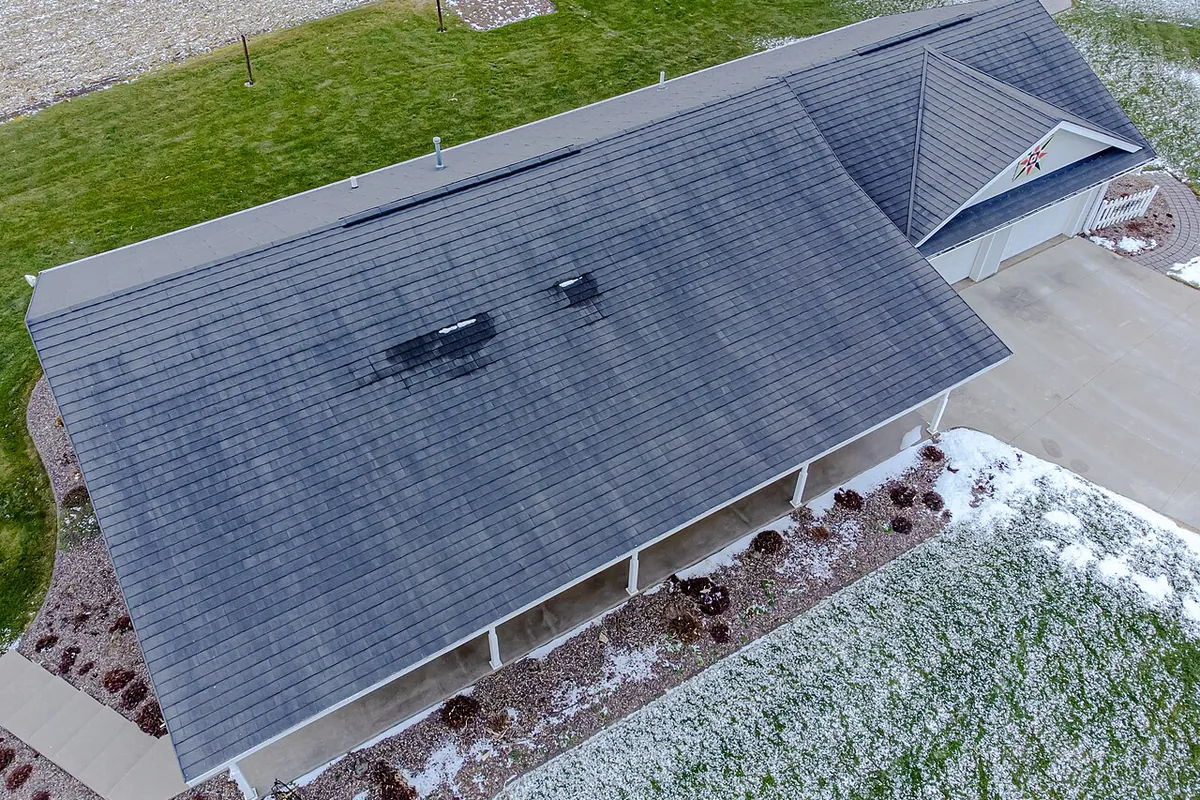
Hail in a snow state
Most New Hampshire hail falls in short, violent summer thunderstorms. Cells build in the afternoon heat, track across Hillsborough and Rockingham counties, and can leave one neighborhood in Hudson battered while the next one over looks untouched. That patchiness is part of the problem: when the adjuster’s own house came through fine, it is easy to assume yours did too.
Hail damage on asphalt shingles is often subtle. Bruised mats, displaced granules and fractured reinforcement may not look like much from the driveway, but they shorten a roof’s life and can let water in years later — usually during the freeze-thaw cycles that New Hampshire winters supply in abundance.
Reading a northern roof
New Hampshire roofs are built for snow. Many are steep, with pitches that need extra labor, staging and safety equipment. They often carry several layers of history: original wood shingles under one or two asphalt overlays, valleys rebuilt by three different roofers, and chimneys flashed with whatever was on the truck. An honest estimate accounts for all of it.
Steep-pitch and height charges
Two-story colonials and capes with 10/12 or 12/12 dormers are common. Steep and high charges belong in the estimate when the roof calls for them. Our roof squares and pitch tool helps you check the math.
Tear-off of extra layers
If the existing roof has more than one layer, the new roof generally can’t go on top. Removing the extra layer is real work and real disposal cost.
Line items that tend to go missing
- Ice and water barrier at eaves and valleys, which current building codes commonly require in cold climates.
- Drip edge, required at eaves and rakes under many code editions.
- Starter course and ridge cap, which are separate products from field shingles.
- Flashing at chimneys, walls and skylights, which can’t always be reused.
- Waste factor that reflects the roof’s actual geometry, not a flat default.
- Gutters, screens and soft metals — the dents on these are often the clearest evidence of hail size.
- Permit fees, which vary by town.
Matching and the discontinued shingle
Shingle lines change. A roof installed in 2012 may use a color or profile no longer made. When the carrier approves only a few slopes, the result can be a patchwork. Whether the policy requires a reasonable match — and what “reasonable” means on a given house — is often the heart of the dispute. We document the existing product, research availability and show the panel what a partial repair would actually look like.
Cosmetic exclusions aside, we also look at whether the carrier’s test squares were representative. A single 10-by-10 square on a north slope doesn’t speak for a south slope that took the brunt of the storm.
Slate, metal and the older roof
Slate is still common on churches, college buildings in Hanover and older homes in Keene and Peterborough. Standing-seam metal is increasingly popular in the Lakes Region and the North Country, where shedding snow matters. Both need specialty pricing. Generic per-square figures rarely capture the real cost.
If a microburst rather than hail took your shingles, our wind and microburst appraisal page covers the differences.
What owners ask about this
How soon after a hailstorm should I file?
As soon as practical. Most policies require prompt notice, and some set specific windows for roof claims. Late reporting can complicate proof of when the damage happened.
The adjuster says my roof damage is wear and tear. Can appraisal fix that?
If the disagreement is really about causation, appraisal may or may not reach it depending on the policy and how the dispute is framed. Talk to us about the specifics, and consider an attorney if the claim was denied.
Do you inspect the roof yourselves?
Yes. We prefer to walk the roof when it is safe, measure it ourselves and photograph every slope rather than rely on aerial imagery alone.